
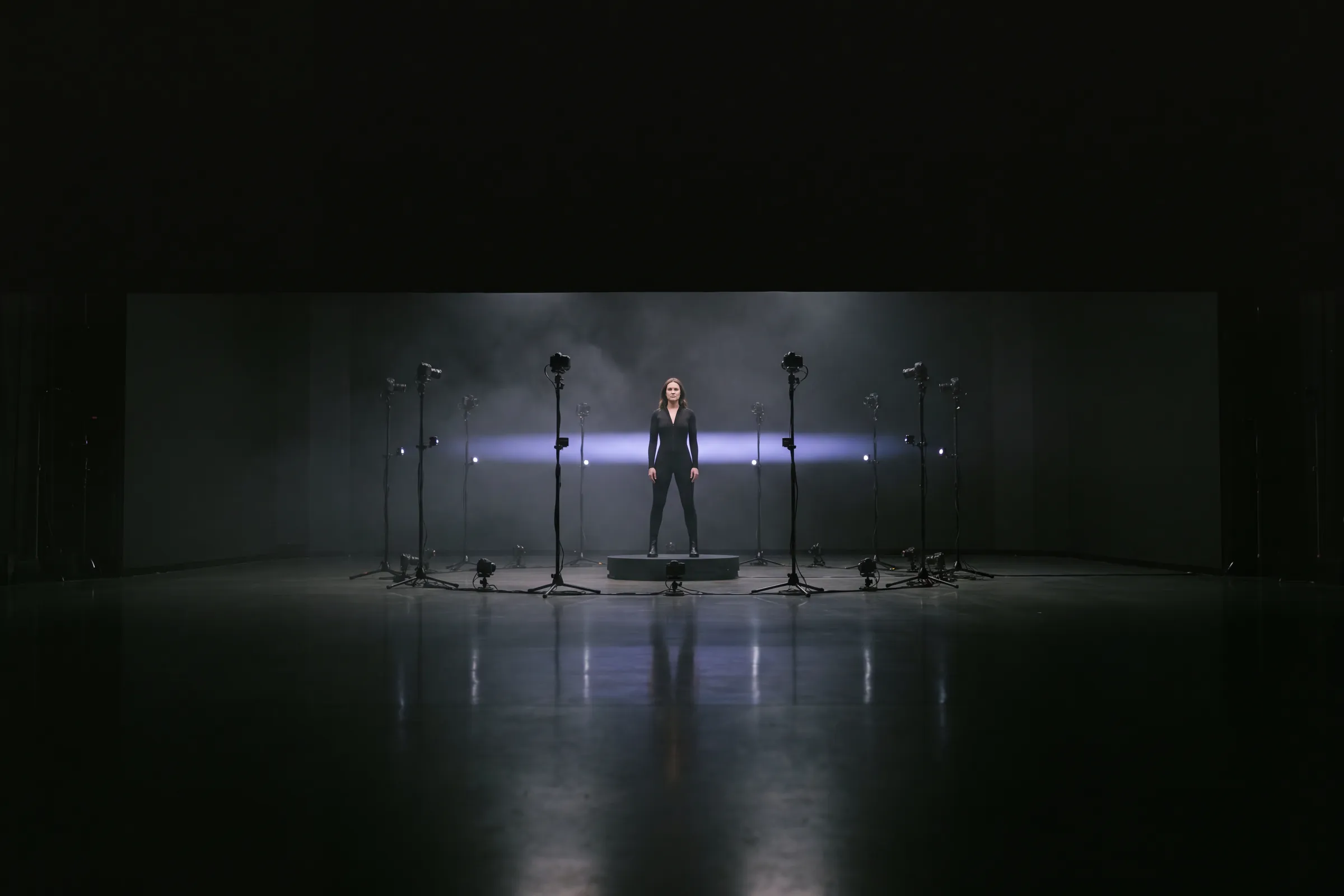
Some AI fashion models are real people. Others are entirely fictional.
The phrase can describe a generated character that has never existed, or campaign imagery based on a real model who has agreed to participate. Those are different things.
At Spencer Models, we represent real people for traditional modeling work. Models who choose to participate can also appear in authorized AI-assisted campaigns produced by our creative team in-house.
The person is real. How the campaign is made can change.
What is an AI-augmented model?
At Spencer Models, an AI-augmented model is a real, represented person who separately authorizes their likeness for approved AI-assisted campaign production.
The term describes an additional way that person can work. It does not mean we invented them, and it does not mean they stop being available for traditional bookings.
The same model might participate in a studio shoot, walk a runway, appear at an event, or approve an AI-assisted campaign built around their likeness.
Traditional representation is available on its own. AI participation is optional. Applying to the agency or signing for traditional representation does not authorize AI use.
The model, the digital representation, and the image
Much of the confusion disappears when you separate three things.
The model is the person. They have a real appearance, personality, and career. They can participate in a physical production and decide which opportunities they accept.
The digital representation depicts that person. A digital replica recreates aspects of someone specific. Fashion brands sometimes call this a digital twin. It is not another person or a promise that every detail is perfectly reproduced.
The campaign asset is the finished work. It might be an image or video combining the model’s likeness with approved digital changes.
Think of an actor appearing in a digitally constructed film environment. The setting can be created without making the actor fictional. The analogy has a limit, though: an AI-assisted depiction does not prove that the model physically performed every pose or action shown.
Not every AI edit recreates the person, either. Changing a background can leave the original photograph of the model intact. The description should explain what actually changed.
How is that different from a synthetic model?
A fully synthetic fashion model is a fictional identity rather than a digital depiction of one particular represented person.
Creative professionals may design, direct, and operate that character. Calling it synthetic does not mean no human creativity was involved.
The distinction is who appears in the finished work. With an AI-augmented human model, the identity traces back to a specific person participating in the arrangement. With a synthetic character, the identity itself is invented.
A virtual influencer is a different label again. It describes a public-facing persona, which may be fictional, based on a real person, or a combination. The label alone does not explain the production.
A real example: H&M’s digital-twin imagery
In July 2025, H&M released images featuring digital twins in fashion-city settings. Its announcement described a collaborative production and included perspectives from photographer Johnny Kangasniemi and model Vanessa Moody.
The useful distinction is that real talent and creative professionals participated in work involving digitally produced imagery. AI did not automatically mean an invented identity.
This is an independent industry example, not a Spencer Models campaign or evidence that our production methods are identical.
How Spencer Models creates campaigns with real talent
Our service combines represented talent and in-house campaign production. Brands commission finished creative work, not software they need to operate.
Start with the person and approved source material
For participating models, authorized photographs and other suitable references provide the starting point. A professional session can establish the model’s appearance and creative range. Additional material may be needed for a particular brief.
Present the opportunity
The model reviews the proposed brand, creative purpose, permitted use, duration, compensation, and relevant restrictions. AI authorization is separate from traditional representation, and the model can decline the opportunity.
Create the campaign in-house
Our team handles creative direction, AI-assisted production, editing, and quality review through our proprietary in-house workflow. The aim is a coherent campaign featuring the participating model, not a collection of unrelated generated faces.
Review and deliver the approved work
The campaign follows the agreed review process, and the delivered assets carry defined usage rights. Model compensation is established in the applicable agreement. One approved license may cover several assets, but it does not authorize unrelated future use.
Our consent and licensing FAQ covers those arrangements in more detail.
What stays real, and what may change?
Imagine a represented model photographed against a plain studio background. With the appropriate approval, our team creates campaign imagery featuring that person’s likeness in a dramatic architectural setting.
The model exists. The setting may be digitally constructed. The image does not establish that the model traveled there or that a physical shoot happened in that location.
That is a hypothetical example, not a description of a completed Spencer Models project.
Depending on the agreed scope, digital production may change settings, styling, lighting, or other elements. Our standard is to preserve the model’s recognizable identity and keep changes within what was authorized.
A real model’s approval does not make every detail in an image automatically true.
Clothing must still be checked against the actual garment. Jewelry must retain the relevant dimensions, details, and finish. A generated image is not a fit test. When references are insufficient, samples or new photography may be necessary.
The FTC’s advertising guidance requires truthful, nondeceptive claims supported by evidence. Product accuracy matters regardless of the production method.
The same applies to personal experience. Showing a model in campaign imagery is different from claiming they wore a garment all day or personally recommend it. The FTC’s endorsement guidance requires endorsements to reflect honest opinions and experiences.
We address appropriate AI disclosure in the campaign requirements. A label does not replace permission or correct an inaccurate claim.
Can the same model still work on set?
Yes. AI augmentation does not turn a working model into a digital-only character.
Brands can book Spencer Models talent for runway, editorial, commercial, print, promotional, fitness, and other traditional work. Physical bookings remain subject to the model’s availability and the agreed assignment.
A brand might photograph a model for a launch and later commission approved digital extensions. Another might need only a conventional booking. Models who do not participate in AI work can pursue traditional representation without it.
The additional licensing opportunity is not a guarantee of bookings or earnings. It is another way for participating talent to work.
For a closer look at the services a brand can commission, read our guide to traditional bookings and AI-assisted campaign production.
Real people, just another way to create
“AI fashion model” does not tell the whole story. Ask whether the identity belongs to a real person, whether that person authorized the work, and who is responsible for producing it.
At Spencer Models, traditional representation and optional AI-assisted campaigns begin with real talent.
AI can change how a campaign is made. It does not have to change whether there is a real person behind it.
Written by Brian Spencer, founder of Spencer Models. Brian’s background includes fashion and editorial photography for publications, sports teams, and modeling agencies, alongside digital marketing and AI-assisted creative production.