
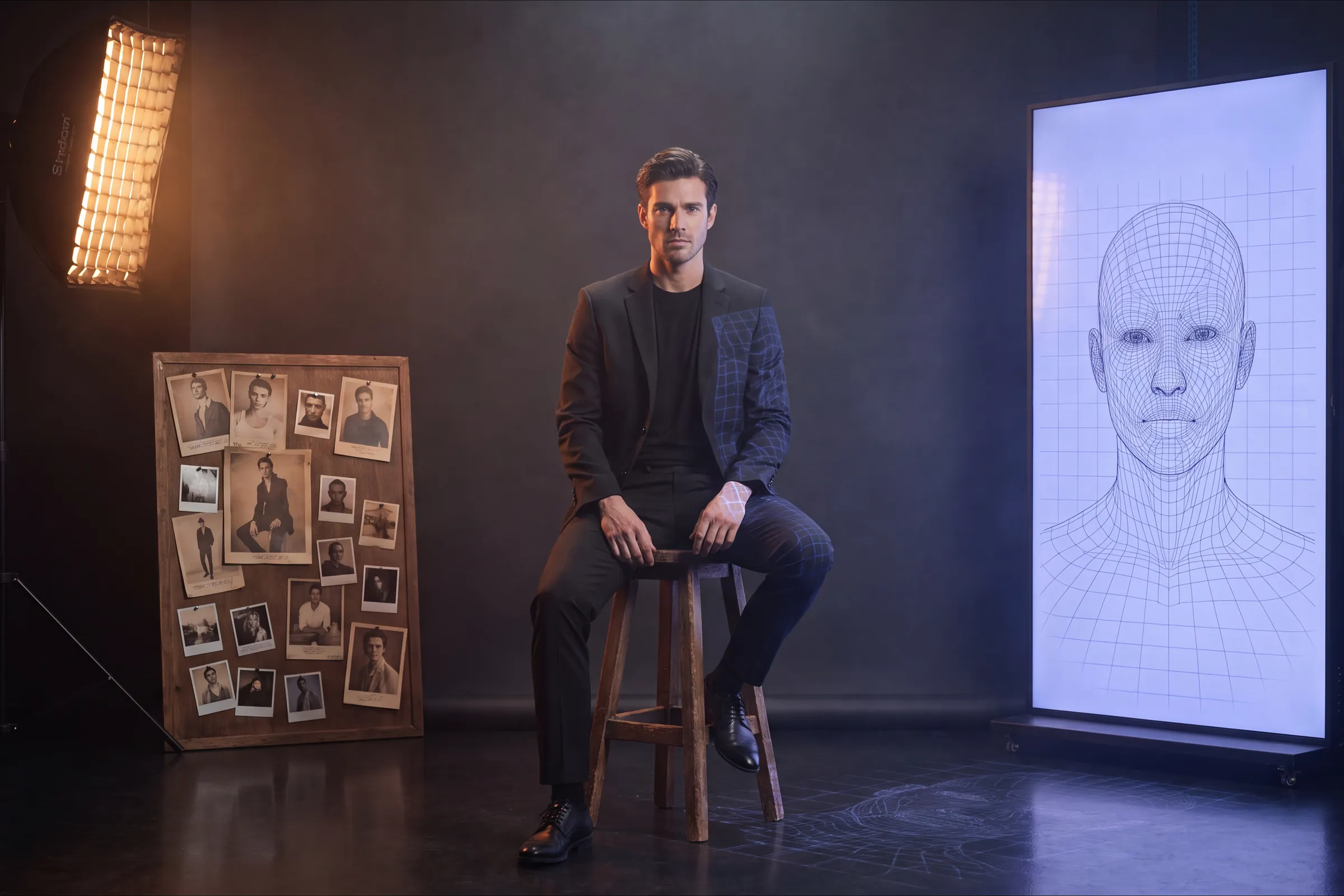
The difference between an AI model agency and a traditional modeling agency is not necessarily who appears in the work. It can be how the work gets produced.
At Spencer Models, we represent real people for traditional modeling work. We also create AI-assisted brand campaigns using the authorized likenesses of participating models, with production handled by our team in-house.
A brand can book a model, commission a finished campaign, or combine both services.
Our AI-assisted production is a managed creative service, not software that clients have to operate themselves.
The useful question is not whether to choose humans or AI. It is which production approach fits your product, creative idea, and budget.
What traditional model representation still provides
Traditional modeling work remains a complete offering at Spencer Models. Brands can book our talent for photo shoots, runway, editorial, commercial, print, promotional, fitness, and event work.
That means working with a real person whose appearance, movement, expression, and presence are part of the assignment.
Already have a photographer, stylist, and production team? A talent booking may be all you need. Hiring a model does not automatically mean commissioning the agency to produce the entire campaign.
The agency label alone does not tell you everything included in a project. Confirm who handles the talent, production, creative direction, and finished deliverables.
What in-house AI-assisted production adds
For brands that need campaign content rather than a talent booking alone, Spencer Models adds another service.
Our team develops and produces approved campaign assets using our real models and a proprietary in-house production workflow. The work includes creative direction, production, editing, and the agreed review process.
The client brings the brief, product information, and business requirements. We handle the creative production within the agreed scope.
An AI-augmented model is still a person. The difference is that an authorized likeness can support new campaign imagery without requiring that person to return to a physical set for every variation.
Think of a film that combines actors with visual effects. Digital production can change the setting without replacing the person behind the performance. The practical decision is what needs to happen physically and what can be created or extended digitally.
Three ways to work with Spencer Models
These are complementary services, not competing definitions of a modeling agency.
| Approach | What you commission | When to consider it |
|---|---|---|
| Traditional booking | Real talent for a shoot, performance, runway, or appearance. Production responsibilities are agreed separately. | You need the model physically present or already have a creative team handling production. |
| AI-assisted campaign | Finished campaign assets produced in-house using a participating model’s authorized likeness. | Your brief can be fulfilled with approved source material and digital production. |
| Hybrid campaign | A live booking combined with separately approved AI-assisted campaign extensions. | You need physical production for some deliverables and digital production for others. |
There is also a simpler option when suitable imagery already exists: license approved existing content rather than commission new production.
One jewelry launch, three possible approaches
Consider a hypothetical independent jewelry brand launching six necklaces. It needs website imagery and social advertising, but its budget will not stretch to several location shoots.
A traditional booking: The brand books a model for a physical shoot. Its production team photographs the actual jewelry on the person, capturing scale, detail, and movement directly.
An AI-assisted campaign: The brand provides accurate product photography, dimensions, and creative references. After confirming feasibility and the model’s authorization, our team develops campaign imagery within the approved brief. The model may not need to travel to the brand or physically wear every piece, although some products still require samples or additional photography.
A hybrid campaign: The brand photographs the jewelry on the model, then commissions approved digital extensions involving new settings, layouts, or campaign variations.
The right choice depends on what must be captured directly and what can be produced accurately from the available material. It is not a contest to use the most AI.
A real example: H&M’s digital-twin imagery
In July 2025, H&M released imagery featuring digital twins. Its announcement described a collaborative production and included perspectives from photographer Johnny Kangasniemi and model Vanessa Moody.
This is an industry example, not a Spencer Models project. It illustrates an important distinction: real talent and creative professionals can remain involved when part of a campaign is produced with AI.
It does not mean every agency offers the same service or that every campaign should follow the same process.
Can AI-assisted production reduce campaign costs?
It can, particularly when a brief would otherwise require additional locations, travel, sets, or repeat production days.
For an emerging brand, that may bring a campaign within reach. But AI does not remove the cost of creative direction, model compensation, production, editing, review, or usage rights.
It is not automatically the cheaper option. A straightforward physical shoot can make more sense than a difficult digital production requiring extensive corrections.
Our campaign pricing considers the selected talent, creative complexity, deliverables, revisions, and intended use. An organic social campaign and a national paid campaign are different licensing requests, even when they use similar images.
Timing also depends on source materials, approvals, and revisions. Compare a defined scope and delivery schedule, not a promise of instant content.
Remote production still has to get the product right
A brand, model, and creative team do not always need to be in the same room. They do need reliable references and a shared understanding of the finished work.
For clothing, that means checking details such as seams, fabric, logos, coverage, and how the garment is presented. For jewelry, it includes scale, stone count, settings, and metal finish.
A convincing image is not a fit test, and an attractive rendering is not proof that the product looks that way.
The FTC’s advertising guidance requires truthful, nondeceptive claims supported by evidence. Our practical standard is to evaluate what the image communicates about the actual product, not just whether it looks polished.
When the available references are insufficient, physical samples or new photography may be necessary. A campaign should not imply personal product experience that never happened.
What should be clear before you approve a campaign?
You do not need access to our internal production methods. You do need to understand what you are commissioning.
The work: Confirm the creative direction, deliverables, formats, revision allowance, schedule, and who reviews the finished assets.
The inputs: Establish which product references and model source materials are required, whether new photography is needed, and whether the materials are authorized for the intended production.
The rights: Agree on the brand, campaign purpose, channels, territory, duration, paid advertising, exclusivity, compensation, and relevant restrictions.
At Spencer Models, traditional representation does not automatically authorize AI use. Participating models approve the relevant campaign and permitted scope through a separate written authorization. Final asset review follows the applicable agreement.
A campaign license also is not blanket permission for unrelated training, future campaigns, or unrestricted reuse. Our consent and licensing FAQ explains the distinctions.
Choose the production around the idea
A runway presentation needs a person on the runway. A campaign built around real reactions or a physical product demonstration may need a live shoot. A series of approved visual variations may be better suited to AI-assisted production.
Some projects need both.
Spencer Models brings traditional representation and in-house AI-assisted campaign production into one agency relationship. You can hire either service without being pushed into the other.
Real models for traditional bookings. In-house creative production for AI-assisted campaigns. One agency for either approach, or both.
Bring us the brief
Tell us about the product, audience, creative direction, budget, launch date, and content you need. Include where the campaign will run and whether it involves paid advertising.
You do not need to decide on the production method before contacting us. We can assess the brief, identify suitable talent, and define an approach around the actual work.
Frequently asked questions
Can I book a Spencer Models model without commissioning AI work?
Yes. Traditional bookings are available independently. You can book talent for your own production team, event, or other agreed assignment without adding AI-assisted services.
Do I need to send physical clothing or jewelry?
It depends on the brief and available references. Some campaigns can use suitable product photography and specifications. Others require samples, additional photography, or a physical shoot to represent the product accurately.
Can the same model appear in a live shoot and an AI-assisted campaign?
Yes, when the selected model participates in AI licensing and approves the relevant use. The live booking and digital production must each be covered by the appropriate terms, and physical bookings remain subject to availability.
For models considering representation, AI participation is optional.
➤ Learn more or apply for representation.
Written by Brian Spencer, founder of Spencer Models. Brian’s background includes fashion and editorial photography for publications, sports teams, and modeling agencies, alongside digital marketing and AI-assisted creative production.