
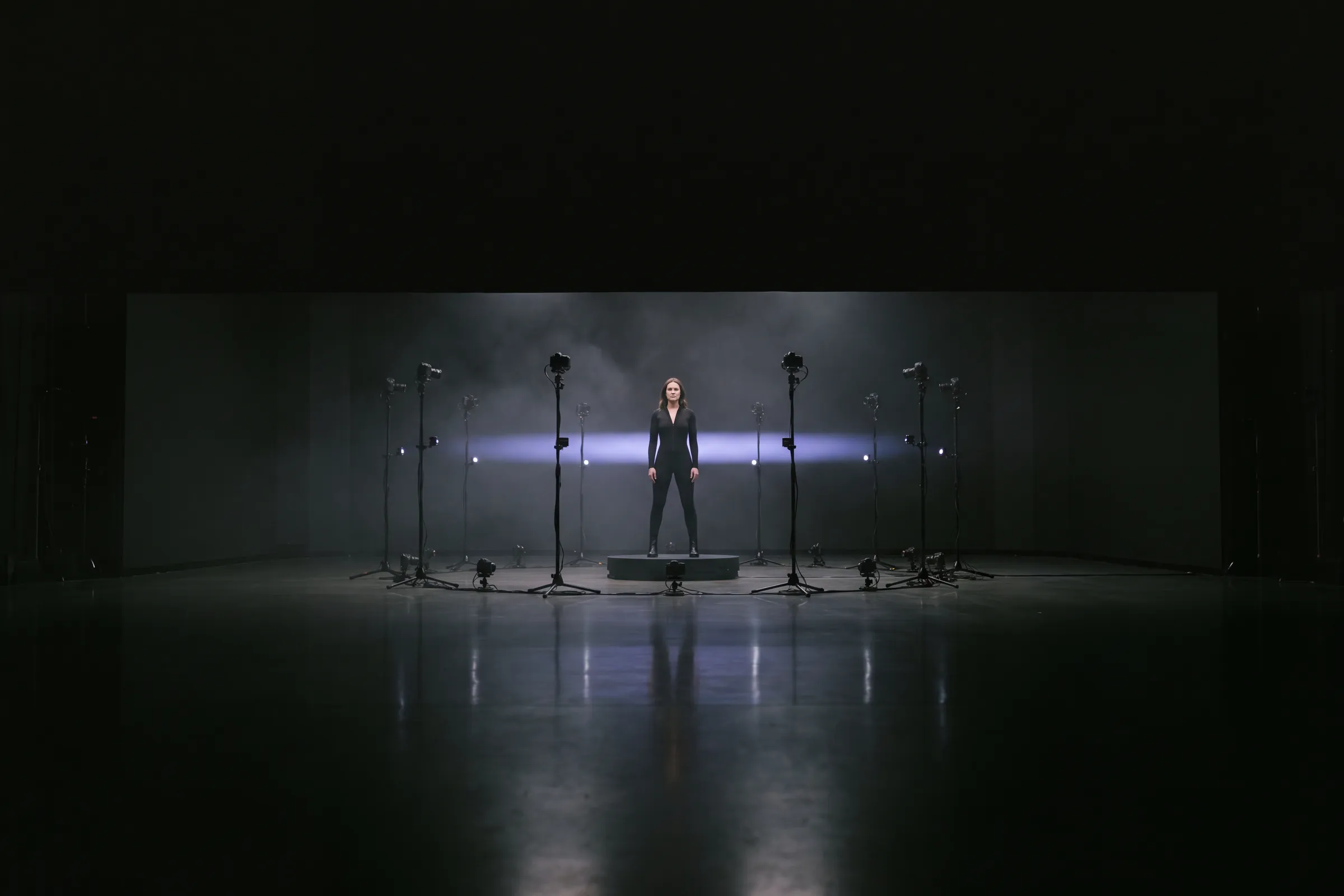
At Spencer Models, an AI-augmented model is a real person whose approved likeness may be used in AI-assisted production under a defined license and separate written consent.
The model remains the human source of the identity. Before a deal moves forward, the model reviews the proposed brand, creative purpose, channels, territory, term, compensation, and restrictions that apply.
The person exists. The person approves the deal and its permitted scope. The person participates in the value created from their likeness.
That is different from a fully synthetic model, whose identity is generated without being based on one specific represented human.
The modeling industry is adopting AI faster than it is agreeing on vocabulary. Terms such as digital replica, digital twin, synthetic model, virtual influencer, and AI model are often used as though they mean the same thing. They do not.
Some describe a person. Some describe a digital representation. Some describe a campaign asset or a public-facing persona. More than one term can apply within the same project.
This article explains how those terms relate and the human-first standard Spencer Models uses when AI-assisted production involves real talent.
Why the terminology matters
AI expands what can be created from source material, which makes it more important to define what has actually been authorized.
A brand may receive rights for one campaign without receiving rights for a future campaign. A model may approve AI-assisted production for a defined commercial purpose without authorizing unrelated model training, open-ended reuse, or unrestricted control over their identity. A license may cover several deliverables and placements without transferring every right connected to the person or the content.
Clear language should answer practical questions before production begins:
- What may be created?
- Which source materials may be used?
- Which client, brand, product, and category are involved?
- Where may the content appear?
- How long may it be used?
- Does the license include paid media, derivatives, or exclusivity?
- What does the model review and approve?
- How is the model compensated?
- What happens when the license or representation relationship ends?
That clarity protects the model, the agency, and the brand.
The five terms brands and models keep confusing
These terms are not five mutually exclusive categories. They describe different layers of a project: the person, the digital representation, the campaign output, or the persona presented to the public.
AI-augmented model
At Spencer Models, an AI-augmented model is a real, represented person who has separately opted into approved AI-assisted likeness licensing.
“AI-augmented” describes an additional way the model may work. It does not mean the person is artificial, and it does not mean the agency receives unlimited rights to the model’s identity. Traditional representation can exist on its own. AI-assisted use requires a separate agreement and deal-specific approval.
Digital replica
A digital replica is a computer-generated or AI-enhanced representation of a specific real person. It may involve the person’s face, body, voice, movements, performance, or a combination of those attributes.
New York’s Fashion Workers Act uses this term for a representation that recreates or replaces a model’s appearance or performance. Its definition excludes routine edits such as color correction, minor retouching, and standard post-production changes.[1]
The phrase digital twin is sometimes used informally in modeling, entertainment, and marketing. Spencer Models does not treat it as automatically interchangeable with every legal or contractual use of “digital replica.” For contracts and compliance, the definition in the governing agreement or applicable law matters more than the label alone.
Synthetic model
A synthetic model is a generated identity that is not based on one particular represented human.
That does not mean no people are involved. Artists, creative directors, photographers, developers, writers, studios, and platform operators may all contribute to the character and its output. A studio or brand may control the persona, accounts, source materials, trademarks, and commercial strategy, but the statement “the company that generated it owns it” is too simple.
Rights in the character and individual outputs depend on contracts, intellectual-property law, and the amount of human authorship involved. The U.S. Copyright Office has stated that generative-AI output may receive copyright protection when a human author determines sufficient expressive elements, but mere prompting alone is not enough.[2]
Virtual influencer
A virtual influencer is a public-facing character or persona presented through social media or other digital channels.
The term describes the role the persona plays, not necessarily how it was created. A virtual influencer may be fully synthetic, fronted by a real person, or built as a hybrid of human performance and digital production.
Spencer Models’ influencer-persona casting model is human-fronted: one real person co-creates and anchors the persona under a separate agreement covering identity, voice, approvals, boundaries, compensation, disclosure, and exit terms.
AI-assisted campaign content
AI-assisted campaign content is the output, not the person.
It may include imagery, video, audio, or variations produced with AI tools from approved source material. The underlying subject may be an AI-augmented human model, a synthetic character, or another licensed creative asset.
At Spencer Models, AI-assisted content involving represented talent must remain within the approved creative and licensing scope and must carry the disclosure appropriate to the platform, format, and campaign.
| Term | What it describes | Specific human source? | Who authorizes commercial use? | How compensation is handled |
|---|---|---|---|---|
| AI-augmented model | A real person and the agency’s human-backed licensing relationship | Yes | The model approves the deal and permitted scope in writing | The model receives contract-defined compensation from the approved license |
| Digital replica | A digital representation of a specific person | Yes | The person or authorized representative, under the agreement and applicable law | Defined in the applicable agreement |
| Synthetic model | A generated identity not based on one represented person | No single represented human | The operator, client, and other rights holders under their agreements | Creators, operators, vendors, and rights holders are paid under their contracts; no represented-model likeness royalty exists |
| Virtual influencer | A public-facing character or social persona | It may or may not | The operator and, when human-backed, the participating person under the governing agreement | Depends on the persona, ownership, talent, and revenue-share agreements |
| AI-assisted campaign content | The finished or derivative campaign output | It depends | Determined by the underlying talent, content, production, and license rights | Defined by the project and license terms |
How does AI-augmented representation work?
Spencer Models separates traditional representation from AI authorization. Applying to the agency does not authorize AI use, and signing a traditional representation agreement does not automatically opt a model into AI-assisted production.
The process has four parts.
1. Represent the real person
The model is represented as human talent for the work covered by the representation agreement. Traditional bookings may include runway, editorial, commercial, print, promotional, fitness, events, and other productions requiring the model’s physical presence or performance.
AI augmentation is optional and separately documented.
2. Establish approved source material
For models who opt in, an initial founding session creates professional source material and approved visual references for potential AI-assisted production.
The session expands what brands may commission. It does not eliminate future shoots. When a campaign requires new photography, video, fittings, runway, appearances, or on-set performance, that work remains a separate live booking.
3. Present a specific opportunity
Before a likeness is used, the model receives the information required by the agreement, which may include:
- The client and brand
- The product or category
- The creative purpose
- The proposed deliverables
- The media and channels
- The territory
- The license term
- Paid-media use and reach
- Exclusivity
- Compensation
- Restrictions and prohibited uses
- Any required final-asset review
No required written approval means no AI-assisted use.
4. Produce and license within the approved scope
After approval, Spencer Models produces or manages the authorized content, documents the usage rights, applies the required disclosure terms, and administers the license.
The model receives the contracted royalty or other compensation defined for that approved license. One license may cover multiple assets, sizes, edits, or placements when they all fall within the approved scope. A new campaign or materially different use outside that scope requires new approval.
One founding session can therefore support two distinct opportunity lanes: live bookings and separately approved AI-assisted licensing. Neither guarantees work, and one does not replace the other.
How is an AI-augmented model different from a synthetic model?
Fully synthetic models can offer brands speed, consistency, extensive creative control, and freedom from live-production scheduling. Those are real advantages for certain campaigns.
Human-backed likeness licensing offers something different: continuity, consent, and participation.
An AI-augmented model can approve or decline an opportunity. The same person can attend a launch, participate in a live shoot, create approved social content, speak about a collaboration, or continue the relationship across future campaigns. The identity in the asset traces back to a real person who chose to participate and shares in the commercial value created from their likeness.
A synthetic character exists inside the creative and commercial system built around it. An AI-augmented model can move between digital production and the physical world.
That is the Spencer Models distinction. The offering is not merely a generated face. It is a managed chain of real talent, documented consent, creative production, compensation, disclosure, and defined usage rights.
Does the model have to consent to every AI use?
Under the Spencer Models standard, every AI-assisted deal involving a model’s likeness requires written approval that defines the permitted scope.
That does not necessarily mean the model signs a new form for every crop, file size, platform placement, or approved variation. It means those uses must be covered by the deal the model approved. If a brand wants a new campaign, a new category, a longer term, a new territory, a new channel, or another use outside the approved scope, additional approval is required.
Applying for representation is not consent. Traditional representation is not consent. A portfolio submission is not consent. AI-assisted use begins only after the separate agreement and required deal approval are in place.
New York’s Fashion Workers Act reflects this distinction for covered model-management companies and clients. It requires clear written approval, separate from the representation agreement, that addresses the scope, purpose, rate of pay, and duration of a model’s digital-replica use. New York’s guidance also states that a new campaign requires new approval when it was not covered by the original authorization.[1][3]
This is general information, not legal advice. Models, agencies, and brands should have their agreements reviewed for the jurisdictions and campaigns involved.
How should AI-assisted model content be disclosed?
Spencer Models requires appropriate disclosure of AI-assisted content involving represented talent.
The exact disclosure depends on the platform, format, creative treatment, campaign, and applicable rules. A platform label may be required in one context, while a caption, advertisement disclosure, asset notation, metadata, or contract instruction may be appropriate in another.
For example, TikTok requires creators to label AI-generated content containing realistic images, audio, or video and provides creator-applied and automatic labels.[4] YouTube requires creators to disclose realistic content that has been meaningfully altered or synthetically generated.[5]
Disclosure is not a substitute for consent or licensing. A properly labeled asset can still be unauthorized, and an authorized asset may still need platform-specific disclosure before publication.
What this means for brands
You license defined rights. You do not buy a person.
A Spencer Models license can define the selected talent, creative scope, deliverables, channels, territory, term, paid-media reach, exclusivity, compensation, restrictions, and disclosure requirements.
Because approved source material may already exist, AI-assisted production can reduce the need to schedule another physical production day for every variation. It can also extend an approved campaign into additional formats, placements, or phases without separating the creative identity from the real person behind it.
The efficiency does not remove the boundaries. New uses remain subject to the model’s agreement and the license.
What this means for models
AI augmentation is optional. It is not a condition of applying for or receiving traditional representation from Spencer Models.
Models who opt in can review proposed opportunities, decline brands or categories, approve the permitted usage, and receive contract-defined compensation when an approved license uses their likeness. Their live modeling work remains a separate opportunity path.
The applicable agreements and Spencer Models’ Privacy Notice explain how source materials, digital-likeness assets, approvals, records, retention, deletion, and post-termination obligations are handled.
AI-assisted licensing may create an additional income opportunity, but it is not a promise of bookings, campaign volume, or guaranteed earnings.
Frequently asked questions
Is an AI-augmented model the same as a digital replica?
No. An AI-augmented model is the real person and the human-backed representation and licensing relationship. A digital replica is a digital representation of that specific person. An AI-augmented model may authorize a digital replica for an approved campaign, but the terms describe different parts of the arrangement.
Does approving one AI-assisted campaign authorize future campaigns?
Not under the Spencer Models standard. The approval covers the brand, purpose, usage, term, and other rights defined in that deal. A new campaign or another use outside that approved scope requires new approval.
Does standard retouching make an image a digital replica?
Not under New York’s Fashion Workers Act definition. Routine color correction, minor retouching, and standard post-production modifications are excluded. More substantial AI creation or alteration may be treated differently depending on the work, agreement, and applicable law.
Can an AI-augmented model still book live work?
Yes. AI augmentation is an optional additional production and licensing path. Live shoots, runway, appearances, events, and other work requiring the model’s physical participation remain separate bookings.
Does the model approve every individual asset?
The model approves the deal and its permitted scope in writing. The governing agreement determines whether the model also reviews each final asset. Multiple deliverables or placements can fall under one approved license when they remain within scope; a new or materially different use requires additional approval.
Can a brand buy a model’s likeness outright?
Spencer Models does not offer brands unrestricted, perpetual ownership of a model’s identity. Brands receive only the content and usage rights stated in the applicable license. Spencer Models treats rights in the model’s identity and rights in an individual campaign asset as separate contract questions, each of which must be addressed in the applicable agreements.
Written by Brian Spencer, founder of Spencer Models & Management, Inc. Last reviewed July 28, 2026.
Sources and further reading
- New York State Department of Labor — Fashion Workers Act Definitions
- U.S. Copyright Office — Copyright Office Releases Part 2 of Artificial Intelligence Report
- New York State Department of Labor — Fashion Workers Act FAQs
- TikTok Help Center — About AI-Generated Content
- YouTube Help — Disclosing Use of Altered or Synthetic Content